
Finding the right Adhd therapy in attapur can help parents understand their child’s attention, behaviour, learning, and emotional needs. Early intervention provides children with structured support to improve daily functioning while helping parents respond to challenges with greater confidence and clarity.
Attention-Deficit/Hyperactivity Disorder, commonly called ADHD, is a neurodevelopmental condition. It can affect a child’s ability to concentrate, control impulses, regulate activity levels, organise tasks, manage emotions, and participate in learning.
ADHD is not caused by poor parenting, excessive energy, laziness, or a lack of discipline. Children with ADHD may genuinely find it difficult to control certain behaviours, even when they understand what is expected of them.
With proper assessment and individualised intervention, children can learn practical strategies to improve their attention, behaviour, communication, academic participation, social interaction, and independence.
Understanding ADHD in Children
Every child becomes distracted, restless, impatient, or emotional occasionally. These behaviours become a concern when they are persistent, appear in more than one setting, and interfere with the child’s education, relationships, routines, or daily activities.
ADHD may present differently in each child. Some children primarily experience attention difficulties, while others demonstrate hyperactivity and impulsivity. A third group may show a combination of both.
Children with attention difficulties may appear to be daydreaming or not listening. They may forget instructions, lose belongings, make avoidable mistakes, or leave activities incomplete.
Children with hyperactivity may constantly move, talk excessively, leave their seats, climb in unsuitable situations, or find quiet activities difficult. Their behaviour is not necessarily intentional or disrespectful.
Impulsive children may answer questions before they are completed, interrupt conversations, take things without permission, or act without thinking about possible consequences.
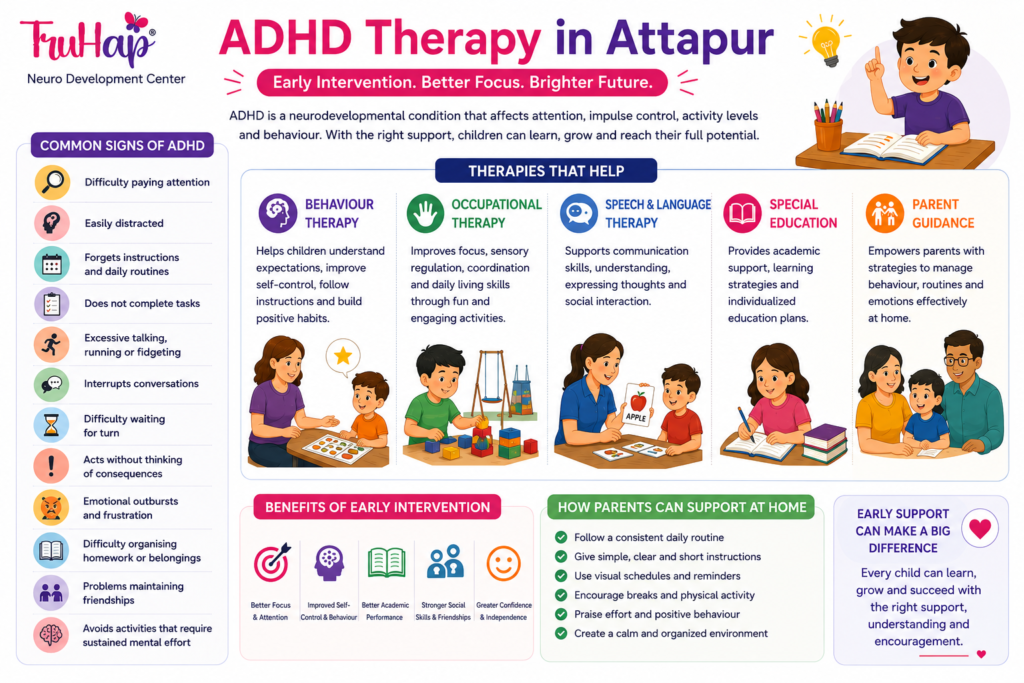
Common Signs That May Require Attention
Parents and teachers may notice certain patterns in a child’s behaviour, learning, and interactions. These may include:
- Difficulty concentrating on an activity
- Becoming distracted by nearby sounds or movements
- Frequently losing pencils, books, toys, or school materials
- Forgetting instructions and everyday routines
- Starting activities without completing them
- Difficulty sitting during class or mealtimes
- Excessive talking, running, climbing, or fidgeting
- Interrupting other people’s conversations
- Difficulty waiting for a turn
- Acting without considering consequences
- Frequent emotional outbursts
- Becoming frustrated with challenging activities
- Difficulty organising homework or personal belongings
- Problems maintaining friendships
- Avoiding activities that require sustained mental effort
The presence of these behaviours does not automatically confirm ADHD. A child may show similar difficulties because of anxiety, sleep problems, learning disabilities, sensory concerns, language delays, emotional distress, or other developmental conditions.
Therefore, parents should avoid self-diagnosis based on online checklists. A comprehensive professional assessment is needed to understand the reasons behind the child’s difficulties.
Adhd therapy in attapur: Why Early Intervention Is Important
Early childhood is an important period for developing attention, communication, social interaction, emotional regulation, motor coordination, and learning readiness. Timely intervention can help children practise these abilities during an active stage of development.
Early intervention does not mean placing a label on a child. It means identifying the child’s strengths, recognising areas that require support, and creating practical goals based on everyday needs.
When intervention begins early, therapists can address difficulties before they have a greater impact on school performance, confidence, friendships, family relationships, and daily routines.
A child who is frequently corrected may begin believing that they are careless, disobedient, or incapable. Therapy shifts the focus from blame to skill development.
Instead of repeatedly telling a child to “pay attention,” therapists identify what is affecting attention. They then use structured activities, visual cues, movement breaks, positive reinforcement, and environmental changes to support participation.
Therapies That Can Help Children With ADHD
There is no single therapy plan suitable for every child. Intervention should be based on the child’s age, strengths, difficulties, school demands, family priorities, and assessment findings.
Behaviour Therapy
Behaviour therapy helps children understand expectations and develop appropriate responses. It may address impulsivity, emotional outbursts, task avoidance, aggression, difficulty following instructions, and challenges with waiting.
Therapists may use visual schedules, reward charts, positive reinforcement, structured choices, and predictable consequences. Desired behaviours are taught gradually and practised consistently.
Positive reinforcement focuses on noticing and rewarding helpful behaviour. For example, instead of only correcting a child for leaving the chair, an adult can appreciate the child for remaining seated and completing a short activity.
Occupational Therapy
Some children with ADHD experience sensory regulation difficulties, poor body awareness, weak motor coordination, or challenges with handwriting and self-care. Occupational therapy focuses on functional skills needed at home and school.
Activities may include movement exercises, obstacle courses, balance tasks, fine-motor work, visual-motor activities, handwriting practice, and sensory-regulation strategies.
An occupational therapist may also recommend practical classroom changes. These can include planned movement breaks, a less distracting seating position, shorter written tasks, or appropriate sensory tools.
Speech and Language Therapy
ADHD can affect a child’s ability to listen, understand lengthy instructions, organise thoughts, stay on topic, and participate in conversations. These difficulties may interfere with social interaction and classroom learning.
Speech and language therapy can support listening, receptive language, expressive communication, storytelling, social communication, and conversational skills.
The child may practise waiting for a turn, understanding social cues, maintaining a topic, asking for clarification, and expressing emotions appropriately.
Special Education
Children with ADHD may struggle with reading, writing, spelling, mathematics, memory, comprehension, or completing academic work. Special education provides instruction according to the child’s learning profile.
A special educator may divide lessons into smaller steps, use visual aids, provide repeated practice, and alternate between written and activity-based learning.
The objective is not simply to increase homework. It is to help the child understand concepts, develop effective learning strategies, and participate more independently.
You can find qualified and expert ADHD therapists in Attapur, Hyderguda.
An Example of Early Intervention
Aarav, a seven-year-old with attention, impulsivity, and handwriting difficulties, began behaviour and occupational therapy after a professional assessment. With visual routines, movement breaks, and short homework tasks, he gradually improved his focus, organisation, turn-taking, and emotional regulation.
Supporting a Child at Home
Parents can make small changes that improve structure and reduce frustration. These strategies should be adjusted according to the child’s age and abilities.
Helpful home strategies include:
- Maintain regular sleep, meal, study, and play routines.
- Give one brief instruction at a time.
- Make eye contact before giving important directions.
- Ask the child to repeat the instruction.
- Divide long activities into smaller steps.
- Use pictures, checklists, calendars, and timers.
- Provide planned movement breaks.
- Reduce noise and visual distractions during homework.
- Praise specific positive behaviours immediately.
- Offer limited and appropriate choices.
- Prepare the child before changing activities.
- Avoid comparing the child with siblings or classmates.
Parents should focus on achievable goals. Expecting a child to sit for an hour may create repeated failure, while beginning with a shorter duration can provide an opportunity for success.
Praise should be specific. Saying, “You completed all three questions before taking a break,” is more informative than simply saying, “Good job.”
ADHD Support at TruHap Neuro Development Centre
TruHap Neuro Development Centre supports children with ADHD, autism, developmental delays, communication concerns, behavioural challenges, sensory difficulties, and learning needs.
Depending on the assessment, a child’s plan may include psychological support, behaviour therapy, occupational therapy, speech therapy, special education, and parent guidance.
Every Child’s Progress Is Different
ADHD does not define a child’s intelligence, personality, or future. Many children with ADHD are creative, energetic, curious, and capable of approaching problems in original ways.
Progress may be gradual and different for every child. One child may first improve in sitting tolerance, while another may show progress in communication, emotional control, organisation, or academic participation.
The aim of intervention is not to change the child’s personality. It is to help the child build skills, reduce functional difficulties, and participate more confidently in everyday life.
Families considering Adhd therapy in attapur should seek a comprehensive assessment rather than waiting for difficulties to become more severe. Early, individualised, and consistent support can give children and parents a clearer path forward.
Questions and Answers
1. What is ADHD?
ADHD is a neurodevelopmental condition that may affect attention, activity level, impulse control, organisation, emotional regulation, and learning. Its presentation varies between children.
2. Does every active child have ADHD?
No. Activity and occasional distraction are normal during childhood. ADHD is considered when symptoms are persistent, occur across settings, and significantly interfere with everyday functioning.
3. At what age can ADHD concerns be assessed?
Concerns can be evaluated when they begin affecting the child’s daily life. Professionals consider the child’s age, developmental level, environment, and behaviour at home and school.
4. Can ADHD be cured completely?
ADHD should not be presented as a condition that can simply be cured. Appropriate therapy, parent support, school accommodations, and medical guidance can help manage symptoms and improve functioning.
5. Which therapy is best for ADHD?
The most suitable therapy depends on the child’s assessed needs. Behaviour therapy, occupational therapy, speech therapy, special education, psychological support, or a combination may be recommended.