
A Speech Therapist for Kids plays an important role when a child finds it difficult to use words, form sentences, pronounce sounds clearly, or understand spoken language in daily life. Children develop at different speeds, but certain communication patterns may indicate that an evaluation could be helpful.
Communication is more than just speaking. A child also needs to understand others, express needs, ask questions, share feelings, and take part in conversations with confidence.
Identifying concerns early can help parents understand their child better and ensure timely support before communication challenges begin to affect learning, behaviour, or self-esteem.
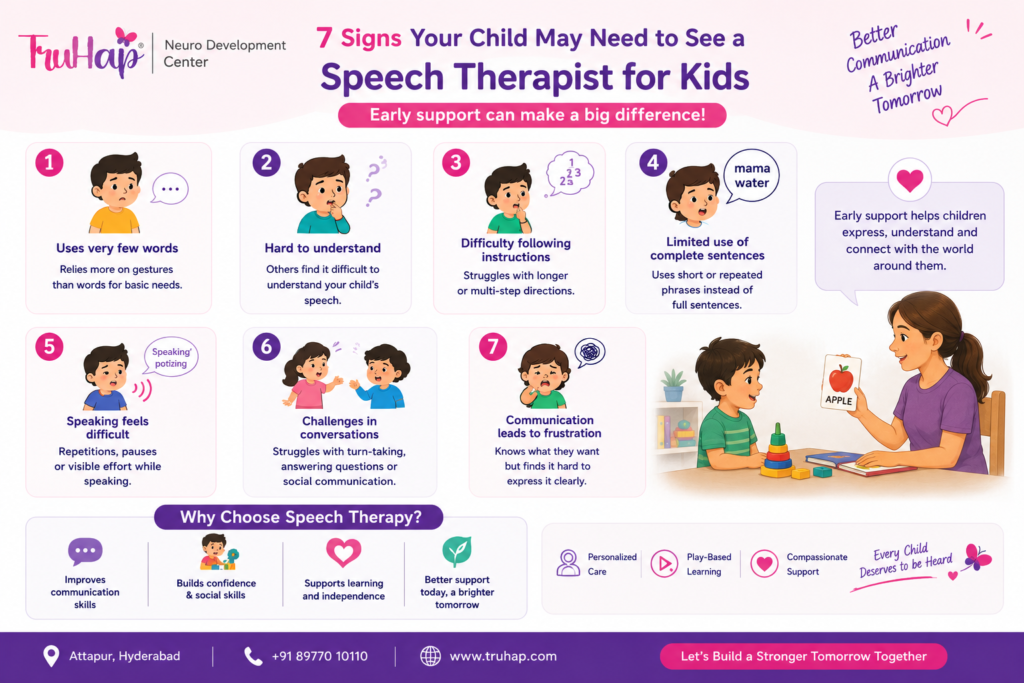
1. Your Child Uses Very Few Words
Some children naturally take longer to start speaking. However, if a child continues to rely mostly on gestures instead of words for basic needs, it may be worth exploring further.
For example, a child may pull a parent toward a snack instead of saying what they want, or point to objects rather than naming them.
Gestures are an important early stage of communication, but over time, spoken words should begin to increase and combine with gestures.
A professional evaluation can help determine whether the child needs support in building expressive language skills.
2. Others Struggle to Understand Your Child
It is common for young children to make pronunciation mistakes as they learn to speak. However, concern increases when even familiar people find it difficult to understand the child regularly.
A child may drop sounds, replace one sound with another, or say the same word differently each time.
Working with a Speech Therapist near me can help improve clarity through structured, play-based speech activities suited to the child’s age and needs.
3. Difficulty Following Spoken Instructions
A child may hear well but still struggle to understand spoken language.
For instance, they may easily follow a simple instruction like “come here,” but get confused when given a longer direction such as “pick up your shoes and keep them near the door.”
This may be due to challenges in understanding vocabulary, remembering steps, or processing multiple instructions together.
A Speech Therapist in attapur can assess these receptive language skills and help the child improve gradually through guided practice.
4. Limited Use of Complete Sentences
Some children know many words but struggle to combine them into meaningful sentences.
A child might say “mumma water” instead of “Mumma, I want water,” or rely on short, repeated phrases.
A Speech Therapist for Kids can support the child in building vocabulary, improving grammar, and forming clearer, more complete sentences for everyday communication.
5. Speaking Feels Difficult or Strained
Parents may notice that a child repeats sounds, stretches words, pauses often, or shows visible effort while speaking.
Some children may also begin avoiding speaking in certain situations because it feels uncomfortable or frustrating.
Instead of correcting the child repeatedly, it is important to understand the cause of the difficulty.
A trained professional at TruHap neuro development center can help identify whether the pattern is part of normal development or requires targeted speech support.
6. Challenges in Conversations With Peers
A child may have a good vocabulary but still struggle in social communication.
They may talk without allowing others to respond, change topics suddenly, or find it hard to answer questions appropriately.
Some children also struggle to enter group play or maintain a back-and-forth conversation.
These skills are an important part of language development and can be improved with structured therapy when needed.
7. Communication Difficulties Lead to Frustration
When a child knows what they want but cannot express it clearly, frustration is common.
They may cry, become upset, or use behaviour instead of words to communicate needs.
This does not always indicate misbehaviour. Often, it is simply the child’s fastest way to express themselves when language is difficult.
Building communication skills through words, gestures, and structured support can reduce frustration and improve interaction.
What Happens During a Speech Assessment?
A speech assessment focuses on understanding how a child communicates in real situations, not just counting words.
A licensed Speech Therapist may observe:
- Clarity of speech sounds
- Vocabulary usage
- Sentence formation
- Understanding of questions
- Ability to follow instructions
- Oral-motor skills
- Conversation abilities
- Fluency of speech
- Functional communication in daily life
Parents also provide valuable insights since children may behave differently at home and in clinical settings.
What Does Speech Therapy Involve?
Speech therapy for children is usually interactive and play-based rather than repetitive drills.
A therapist may use toys, games, stories, pictures, or daily routines to encourage communication.
Depending on the child’s needs, goals may include:
- Requesting items using words
- Improving speech clarity
- Building sentences
- Answering questions
- Developing conversation skills
- Strengthening classroom communication
Each therapy plan is personalised based on the child’s developmental level.
Speech Development in Autism and ADHD
Children with autism may show different communication patterns. Some may speak very little, while others may speak fluently but struggle with social interaction, flexible language use, or understanding social cues.
Families looking for support at a Speech Therapist near me often benefit from centres that provide a complete developmental approach rather than focusing on one area alone.
Children with ADHD may also face challenges such as difficulty listening, staying focused during conversations, or organising their thoughts while speaking.
Speech Therapy Is More Than Pronunciation
Speech therapy is not limited to correcting sounds.
It also focuses on:
- Understanding language
- Building vocabulary
- Forming sentences
- Improving storytelling skills
- Enhancing social communication
- Supporting fluency and confidence
The goal is to help children communicate effectively in real-life situations, not just speak clearly in therapy sessions.
How Parents Can Support at Home
Parents can encourage language development through simple daily interactions.
- Talk during daily routines like cooking or dressing
- Describe actions during play
- Give choices instead of yes/no questions
- Expand the child’s words into sentences
- Read short storybooks together
- Allow time for the child to respond
Even small, consistent interactions can significantly support communication growth.
About TruHap Neuro Development Center
TruHap neuro development center provides Speech Therapy, Occupational Therapy, Behavioural Therapy, and Special Education services designed to support children’s overall developmental needs through personalised care.
Example: From Gestures to Words
A young child was brought for assessment because he mostly used pointing and pulling gestures to communicate.
He understood simple instructions but rarely used spoken words.
Therapy began with functional words like “open,” “more,” “help,” and “water,” introduced during everyday activities.
Parents were guided to pause during routines so the child had opportunities to respond.
Gradually, the child began using single words and later short phrases to communicate needs more clearly.
When Should Parents Seek Help?
If communication difficulties are seen regularly at home, school, or in social settings, it may be helpful to consult a Speech Therapist in attapur or a Speech Therapist near me for an evaluation.
Early assessment does not always mean long-term therapy—it simply helps understand the child’s needs better.
Why Early Support Matters
Communication is essential for learning, social interaction, and emotional expression.
When children struggle to communicate, they may become frustrated or withdrawn.
Early support helps build confidence and ensures children develop the skills they need for everyday life.
The goal is not to make every child speak the same way, but to help each child communicate clearly and confidently in their own way.
Conclusion
Parents are often the first to notice changes or delays in their child’s communication.
If you observe ongoing difficulty with speaking, understanding, or expressing ideas, consulting a licensed Speech Therapist can provide clarity and direction.
With the right support, children can improve communication skills and participate more confidently in daily life.
Frequently Asked Questions
Q1. Does delayed speech always mean a serious problem?
Not always. Some children develop speech later than others, but an assessment helps understand whether support is needed.
Q2. Can a child understand language but still need therapy?
Yes. Some children understand well but struggle to express themselves clearly.
Q3. Will speech problems resolve on their own?
Some may improve naturally, but others may need structured support depending on the cause.
Q4. What can parents do daily to help?
Talking, reading, playing, and encouraging communication during routines are very helpful.
Q5. How long does speech therapy take?
It varies for each child depending on their needs, consistency, and developmental profile.