
Your two-year-old understands everything you say but barely speaks a word. A relative casually says “boys talk late, don’t worry.” A friend’s child the same age is already forming sentences. The doubt creeps in quietly and doesn’t go away: is this just a speech delay, or could it be something more?
This is one of the most common worries parents bring to us at TruHap, and it’s a fair one. Globally, around 1 in 100 children has autism spectrum disorder, and recent Indian estimates suggest the figure may be similar or even higher once underdiagnosis is accounted for — yet most Indian families still don’t get a clear answer until age 4 or 5, well past the window where early intervention works best. This guide breaks down speech delay vs autism in toddlers in plain language, so you know what to watch for and what to do next.
Speech Delay and Autism Are Not the Same Thing
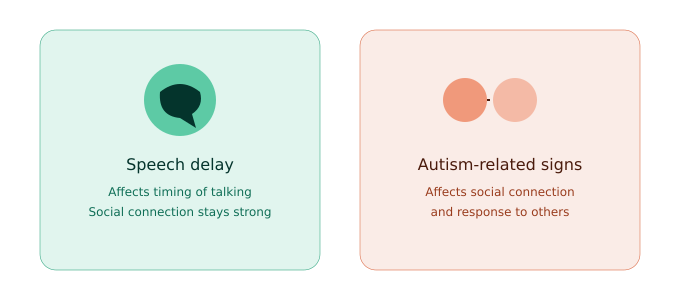
It helps to start with the most reassuring fact: a child with a speech delay is not automatically autistic. Many toddlers who are “late talkers” catch up completely with the right support and no other diagnosis involved.
However, the reverse isn’t true nearly every child with autism also has some degree of speech or language delay. That overlap is exactly why the two get confused, and why parents often spend months unsure of which path to take.
The clearest way to separate them is to look past the speech delay itself and observe how the child connects with people.
Typical Speech Delay
- Understands instructions well (“bring your shoes”) but struggles to express the same thing back
- Maintains eye contact and responds to their name consistently
- Points, waves, and uses gestures to show interest or ask for things
- Enjoys pretend play and engages socially with parents and other children
- Often improves steadily once structured speech support begins
Possible Autism-Related Signs
- Limited or no babbling by 12 months, or loss of babbling/words already learned (regression)
- No single words by 16 months, no two-word phrases by 24 months
- Doesn’t respond to their name by 9–12 months, or seems indifferent to it
- Little to no pointing, waving, or showing objects to share interest
- Reduced eye contact or social smiling
- Repetitive behaviours: hand-flapping, lining up toys, spinning objects
- Strong resistance to changes in routine, or unusual sensitivity to sounds, textures, or lights
One important note for Hyderabad’s many bilingual and trilingual households: children growing up around Telugu, Hindi, English, or Urdu at home can take an extra 3 to 6 months to start speaking compared to monolingual children. This is normal and not a red flag on its own but it shouldn’t be used to explain away the social and behavioural signs listed above.
Why "Wait and Watch" Often Costs Hyderabad Families the Most Valuable Window
Pediatric guidelines are consistent on this point: brain plasticity is highest between 18 months and 3 years, which is exactly when early intervention has the strongest, most lasting effect on language, social communication, and behaviour. Children who start support in this window tend to need shorter overall therapy duration and show better long-term outcomes than those diagnosed later.
In practice, this means a 6-month “let’s just wait” delay isn’t a neutral decision it’s a missed opportunity during the period when therapy works fastest. If you’ve already noticed two or more of the signs above, the next right step isn’t to keep watching. It’s to get a professional opinion.
How Professionals Actually Tell the Difference
You don’t need to diagnose your child yourself, and you shouldn’t try to. At a center like TruHap, the process typically involves:
- Screening tools such as the M-CHAT (Modified Checklist for Autism in Toddlers), used for children aged 16–30 months, alongside broader developmental questionnaires.
- Play-based observation by a speech therapist, who assesses both receptive and expressive language in a natural setting rather than a clinical test.
- Behavioural and social assessment, usually involving our behavioural therapy team, who look specifically at joint attention, social reciprocity, and repetitive patterns.
- Parent interviews, because you see your child in contexts no single session can replicate — at home, with siblings, during meals, during meltdowns.
This is deliberately a team process, not a single test. A child can show speech delay without autism, autism without major speech delay, or a mix of both — and the right therapy plan depends on getting that distinction right rather than assuming.
What to Do If You're Noticing the Signs
- Don’t wait for a “label” before acting. A formal diagnosis can take time, but speech and developmental support can often start the moment delays are identified — you don’t need a diagnosis in hand to begin therapy.
- Track what you’re seeing. Note approximate ages for milestones like first words, response to name, and any skills your child seems to have lost. This makes the first assessment far more useful.
- Get a multidisciplinary opinion, not just a single specialist’s view. At TruHap, an initial concern about speech often involves input from our speech therapy, occupational therapy, and special education teams together, so nothing gets missed.
- Involve the whole family. Our Parent Therapy Integrated Program exists because progress made in a 45-minute session needs to be reinforced at home to actually stick.
- If social connection looks strong, it’s reassuring — but still worth a professional check if speech is significantly behind peers.
Speech delay affects when a child starts talking. Autism affects how a child connects, communicates, and engages with the world — speech is just one part of that picture. The two can look similar in a two-year-old, which is exactly why guesswork (or relying on what worked for someone else’s “late talker”) isn’t a reliable strategy.
If your child is showing several of the signs above, the most useful thing you can do today is get a proper developmental screening — not search for more reassurance online. At TruHap, our child therapies team offers assessments specifically designed to tell speech delay and autism apart early, with licensed therapists and a plan built around your child rather than a generic checklist.